
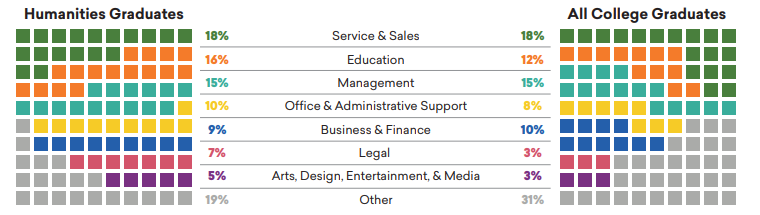
In the 21st century, a humanities center at a flagship state university must be a project that joins an ambitious intellectual agenda with recognition of the practical economic and social benefits that come with a humanities degree. The FSU Humanities Center positions itself as an ongoing project of intellectual leadership as well as an undertaking committed to fine-tuning the study of the humanities in ways that equip humanities graduates to navigate a wide range of work and career environments. In Florida, humanities graduates — compared to all college graduates — provide the largest percentage of persons in the fields of legal work, office and administrative support, education, and media, and their presence likewise is equal to or nearly equal to all college graduates in the career fields of management, business and finance, and service and sales.
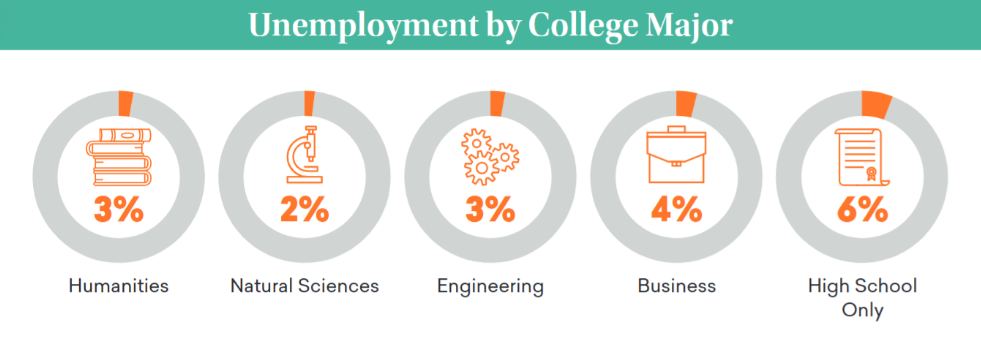
The median earnings of humanities majors in Florida’s full-time workforce is $61,796 per year. That is 70% higher than the median earnings of workers with just a high school degree at $36,397. Additionally, humanities majors are consistently employable: they suffer less unemployment than business majors at 3% versus 4%, and stand equal to engineering majors, both at 3%.[i] In short, the humanities degree is a valuable credential when measured in terms of its economic advantages.
The FSU Humanities Center will clarify and advance the educational mission crucial to a free and prosperous society, advantage our students, and elevate our institution by reinforcing inculcation of the applied skills and intellectual qualities that have made humanities majors a pillar of the Florida economy.
[i] Data and charts are from “Florida’s Humanities Majors: What They Earn and What They Do,” American Academy of Arts and Sciences Humanities Indicators Project, (October, 2023), excerpted here: The AAAS report pointedly challenges the myths about the career usefulness of humanities degrees that have circulated for years.